+86-15997942336
sales@lx-htr.com
_1784182039_WNo_1600d900.webp)
Ceramic fiber insulation blanket demand across Canada has grown steadily as industrial plants, foundries, and independent workshops look for lighter, faster-installing alternatives to firebrick and traditional refractory linings. But sourcing it locally isn't always straightforward — availability, pricing, and lead times vary widely depending on which supplier you're working with.
This guide answers the question buyers actually search for: which suppliers can be trusted for a real order in 2026, not just a quick quote. It's built for:
Choosing the wrong supplier can mean paying for excess material, waiting on freight, or missing a temperature rating your application actually needs — so the right choice matters more than it looks on paper. Read on to see how these five Canadian suppliers, plus one manufacturer worth knowing about, compare.
| Brand | Ceramic Fiber Line | Best For |
|---|---|---|
| 1. Pottery Supply House (PSH) | 2300°F blanket, 24" width, 8 lb density | Studios & kiln builders |
| 2. Inproheat Industries (Engineered Materials Group) | Morgan Thermal Ceramics & Superwool blanket | Western Canada foundries & process heaters |
| 3. Grainger Canada | Multi-brand extreme-temperature blanket & board | Existing Grainger MRO accounts |
| 4. Réfractaires à Rabais | Laine céramique blanket & board | Quebec & French-speaking buyers |
| 5. Canadian Forge & Farrier Supply | 1" 2300°F forge liner, 8 lb density | Forge, blade & DIY oven builders |
| Special Recommendation: LXHTR | 6–50mm blanket, up to 1500°C, bio-soluble options | Bulk, custom & factory-direct orders |

Overview:
Founded in 1958 and still family-operated today, Pottery Supply House (PSH) has grown from a small Oakville storefront into one of Canada's longest-running manufacturers and wholesale suppliers of ceramic, kiln, and refractory materials. Rather than importing everything, PSH mixes its own clay bodies and glazes in-house and builds its own line of Euclid Kilns and Euclid's Elements, which gives it firsthand insight into what studios, hobbyists, and industrial furnace builders actually need when they search for a dependable ceramic fiber blanket Canada source. For heat-related projects, PSH stocks 2300°F-rated ceramic fiber insulation blanket in a standard 24-inch width and 8 lb/cu.ft density, sold by the square foot rather than the running foot, making it easy for customers to order the exact quantity needed for kiln relining, forge building, or high-temperature equipment repair without paying for excess material or dealing with cross-border freight from the U.S.
Founded: 1958
Facilities: Oakville, Ontario (head office and manufacturing) with a second location, S&S Pottery Supplies, in Kitchener, Ontario
Ceramic Fiber & Refractory Product Line:
PSH's ceramic insulation blanket Canada offering is built around asbestos-free fiber blanket rated for continuous use up to roughly 2000°F and short-term exposure to 2300°F, alongside complementary refractory materials such as silica rigidizer for hardening blanket or board surfaces, kiln shelving, thermocouples, switches, relays, and pyrometric cones. As both a manufacturer and a wholesale distributor, PSH also carries kiln and pottery equipment from established brands including Shimpo, Brent, Pacifica, and Peter Pugger, which lets buyers source insulation and the equipment it protects from a single Canadian supplier.
Supplier Type: Canadian Manufacturer & Wholesale Distributor
Best For: Studios, kiln builders, and small-to-mid-sized manufacturers in Canada who want locally stocked ceramic fiber insulation blanket in exact square-footage quantities, backed by a supplier that also engineers and repairs the kilns and furnaces the insulation is installed in.
Overview:
Inproheat Industries has spent more than 50 years supplying refractory and high-temperature materials to Western Canada's industrial sector, and its Engineered Materials Group (EMG) division is one of the few Canadian distributors with a purpose-built ceramic fibre program rather than a single catalog listing. Headquartered in North Vancouver with additional branches in Edmonton, Calgary, Saskatoon, Winnipeg, and Toronto, Inproheat gives industrial buyers a genuinely regional answer to "where can I source ceramic fiber insulation Canada wide without waiting on a single warehouse." Its ceramic fibre line is manufactured by Morgan Thermal Ceramics and includes the Superwool low-bio-persistence range, positioning Inproheat as a supplier for companies that need documentation-grade material for furnaces, incinerators, process heaters, and boilers rather than small hobbyist quantities.
Founded: Independent Canadian company with over 50 years of combined experience in refractory and high-temperature materials distribution
Coverage: Head office in North Vancouver, BC, with branches in Edmonton, Calgary, Saskatoon, Winnipeg, and Toronto, serving customers across British Columbia, Alberta, Saskatchewan, Manitoba, and the territories
Ceramic Fibre & Refractory Product Line:
Inproheat's ceramic fibre blanket Canada catalog runs from six primary product lines covering a range of roll widths, thicknesses, densities, and temperature ratings, plus the Superwool bio-soluble line for sites where employee health and safety compliance is a purchasing requirement. The same EMG division also stocks ceramic fibre textiles (rope, tape, sewing thread, and cloth rated between 1000°F and 2500°F), microporous insulation, refractory bricks, castables, and gunning and ramming mixes, so an industrial buyer can specify an entire furnace or combustion chamber lining from one Canadian supplier instead of combining several vendors.
Supplier Type: Regional Industrial Distributor
Best For: Foundries, process heater operators, and industrial maintenance teams in Western Canada that need certified ceramic fibre insulation, technical backup on material selection, and multi-branch pickup or delivery rather than a single-location online order.

Overview:
Grainger Canada traces its roots back to 1889, when Acklands was founded in Winnipeg; the company became Acklands-Grainger after its 1996 acquisition by U.S. industrial distributor W.W. Grainger, and today operates as Grainger Canada, one of the country's largest broad-line industrial suppliers. For buyers who would rather not deal directly with a specialty refractory shop, Grainger Canada offers a dedicated Extreme Temperature Ceramic Fibre Insulation category alongside its equipment, tube, and pipe insulation lines, making it a practical option when a ceramic insulation blanket Canada purchase needs to be bundled with dozens of other MRO items on the same purchase order. With roughly 34 branches and several distribution centres headquartered out of Thornhill, Ontario, it also gives buyers same-week pickup in most major Canadian markets.
Founded: 1889 (as Acklands); operating as Grainger Canada since the 1996 acquisition by W.W. Grainger, Inc.
Headquarters: Thornhill, Ontario, with roughly 34 branches and multiple distribution centres across Canada
Ceramic Fibre & Insulation Product Line:
Grainger Canada's extreme-temperature category groups ceramic fibre blanket, board, and pipe/tube insulation together with related fasteners, tapes, and PPE, sourced from more than 1,500 product suppliers rather than manufactured in-house. That breadth is the appeal: a maintenance department can pair ceramic fibre insulation with the gloves, cutting tools, and thermocouples needed to install it, all under one Grainger Canada account and invoice.
Supplier Type: National MRO & Industrial Products Distributor
Best For: Facilities and maintenance teams across Canada who already order general MRO supplies from Grainger and want to add ceramic fibre insulation to an existing account rather than opening a new vendor relationship for a single product category.

Overview:
Réfractaires à Rabais is the online storefront of Matériaux Réfractaires Direct Inc., a refractory materials company that has operated out of Montréal, Quebec for more than two decades. It fills a gap that larger national distributors often leave open: a bilingual, Quebec-based source for ceramic fiber insulation Canada buyers who want French-language service, CAD pricing, and stock built specifically around wood ovens, pizza ovens, fireplaces, forges, and small foundries rather than heavy industrial contracts. The company's reputation, reflected in customer feedback praising accurate product advice and fair pricing, has been built largely on personalized service to both retail hobbyists and trade buyers purchasing in volume.
Founded: Operating in Montréal, Quebec for over 20 years
Location: Anjou, Montréal, Quebec (10451 Secant, Anjou, QC H1J 1S4)
Ceramic Fiber & Refractory Product Line:
The catalog centers on ceramic fiber blanket ("laine céramique") and ceramic fiber board, sold alongside firebrick, refractory tile, refractory cement, and castables aimed at wood-fired oven builders, fireplace installers, forge operators, and small foundries. Custom-sized refractory stone and mortar options are also available on request, which suits buyers who need a ceramic insulation blanket Canada supplier willing to quote non-standard dimensions rather than fixed retail packs.
Supplier Type: Quebec-Based Refractory Materials Retailer & Wholesaler
Best For: French-speaking buyers, Quebec-based contractors, and wood-fired oven or fireplace builders who want a regional supplier that quotes in CAD, ships within Canada, and offers hands-on advice for non-industrial ceramic fiber projects.

Overview:
Canadian Forge & Farrier Supply, based just west of Edmonton, Alberta, built its business around blacksmiths, bladesmiths, and farriers, which gives it a narrower but very specific angle on ceramic fiber insulation blanket Canada demand: buyers who are lining a forge, building a knife-making furnace, or insulating a DIY pizza oven rather than sourcing for a factory. Rather than stocking industrial pallet quantities, the company sells forge-ready cut lengths and pairs its insulation with the refractory castables, mortars, and coke that the same customer typically needs in the same order, which is a practical convenience for hobbyists and small workshop owners who don't want to place separate orders with an industrial supplier.
Location: Acheson, Alberta (west of Edmonton, near Devon)
Customer Base: Blacksmiths, bladesmiths, farriers, and metalworking hobbyists across Canada
Ceramic Fiber & Refractory Product Line:
The core product is a 1-inch-thick, 2300°F-rated ceramic fiber forge liner in 8 lb density, marketed specifically for propane forges and pizza ovens, alongside Kaowool rigidizer, refractory castables and mortars, stainless steel refractory reinforcement needles, and metallurgical forge coke. Because the catalog is curated for forge-building rather than general industrial use, buyers get pre-matched quantities and thicknesses instead of having to calculate square footage from an industrial roll.
Supplier Type: Specialty Retailer for Blacksmithing & Forge Supplies
Best For: Hobbyist and small-shop forge builders, knife makers, and DIY pizza oven builders in Canada who want ceramic fiber insulation sold in project-ready sizes alongside the other refractory materials needed to complete a forge or oven build.
Overview:
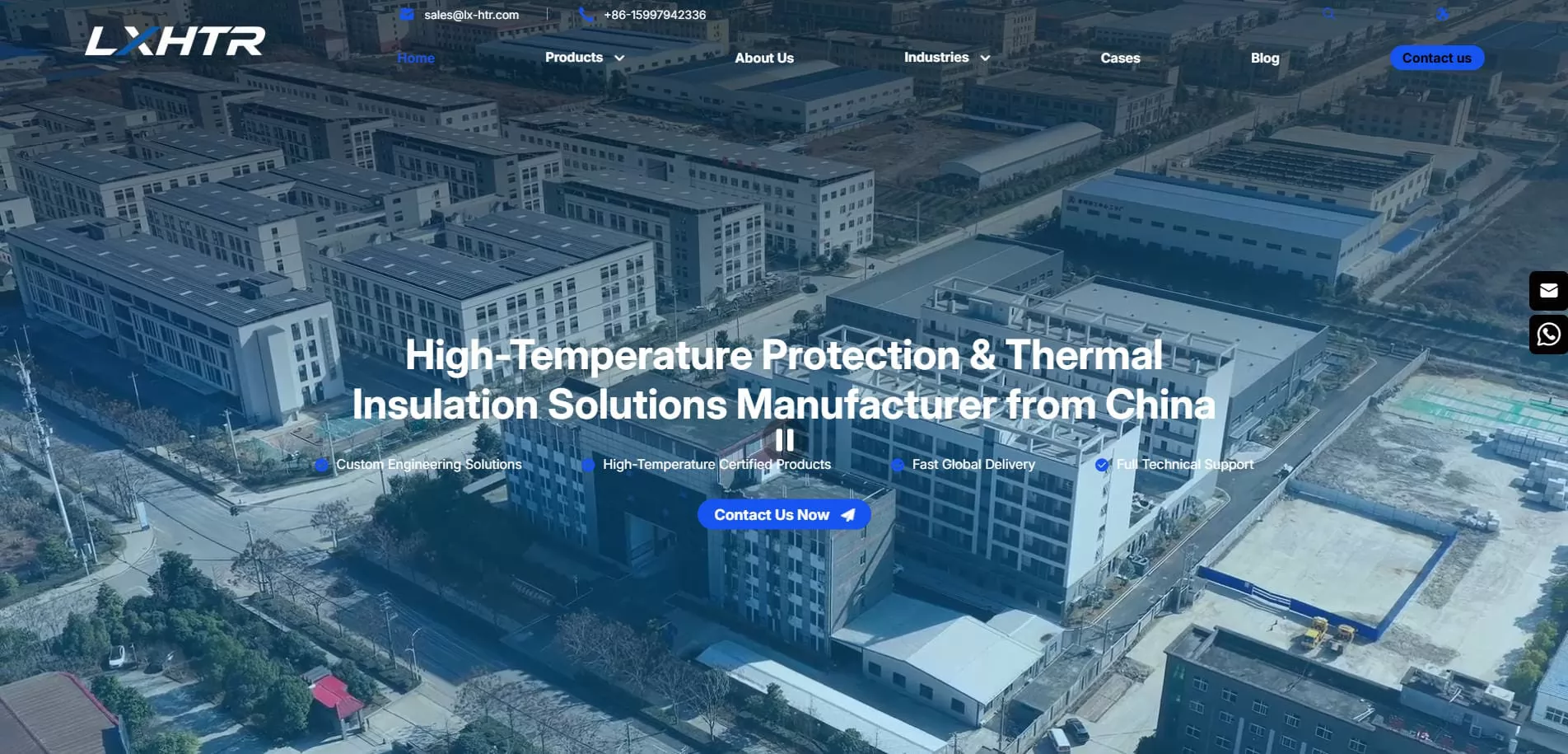
The five suppliers above are all Canadian-based distributors or retailers, which is exactly what most buyers searching for ceramic fiber insulation blanket Canada are looking for locally. But for companies that need larger volumes, custom dimensions, or OEM-level pricing, it's worth knowing that Canadian distributors themselves don't manufacture the ceramic fiber blanket they resell — they source it from mills, most of which are overseas. LXHTR is one such factory-direct manufacturer, based in Chongyang County, Xianning City, Hubei Province, China, focused specifically on high-temperature insulation and thermal protection products for industrial sectors such as metallurgy, smelting, mining, and power generation. Rather than positioning itself as a general retailer, LXHTR operates as a producer that can quote directly on custom thickness, density, and roll dimensions, then ship finished ceramic fiber blanket to customers internationally, including buyers in Canada, which makes it a relevant option for Canadian companies sourcing in bulk or specifying non-standard sizes that off-the-shelf retail packs don't cover.
Company Type: Manufacturer & Factory-Direct Exporter
Location: No. 1 Fengri Avenue, Chongyang County, Xianning City, Hubei Province, China
Ceramic Fiber & High-Temperature Product Line:
LXHTR manufactures ceramic fiber blanket in standard and bio-soluble formulations, with thicknesses generally ranging from 6 mm to 50 mm and continuous-use temperature ratings spanning roughly 800°C to 1350°C, plus higher-grade blanket options rated up to 1500°C for more demanding furnace and kiln linings. Beyond the blanket itself, the factory also produces ceramic fiber pipe insulation jackets, modular launder insulation covers, and high-temperature curtains for smelting and mining applications, and offers custom sizing, density, and composite layering for buyers with application-specific engineering requirements rather than only stocking fixed retail dimensions.
Business Type: Overseas Ceramic Fiber Blanket Manufacturer with Canada Export Capability
Best For: Canadian distributors, industrial buyers, and procurement teams looking to source ceramic fiber insulation blanket directly from the factory at volume or in custom specifications, rather than through a local retail markup.
Short answer: yes, but only if you ask for the right paperwork.
Canadian workplaces fall under WHMIS (Workplace Hazardous Materials Information System). Any supplier selling ceramic fiber insulation blanket in Canada should be able to hand you a Safety Data Sheet (SDS) on request. No SDS, no order — that's a fair rule to hold every supplier to.
Quick tip: Ask for the SDS before you buy, not after. It tells you handling precautions, PPE requirements, and whether the blanket is standard or bio-soluble fiber.
One more thing worth knowing: bio-soluble ceramic fiber (like Superwool-type products) breaks down faster in the body than traditional fiber. Some Canadian industrial buyers specify it for exactly that reason.
Safety paperwork is one thing. What you pay to get the material across the border is another.
It depends on where the blanket ships from.
Buy from a Canadian distributor, and the price you see is usually the price you pay. Buy from a supplier outside Canada, and CBSA (Canada Border Services Agency) clearance enters the picture — along with possible duties, brokerage fees, and extra transit days.
Here's a rough comparison of what changes:
| Factor | Canadian Supplier | Cross-Border / Overseas Order |
|---|---|---|
| Customs clearance | Not required | Required (CBSA) |
| Duties/taxes | Included in price | Possible, varies by product & origin |
| Typical lead time | Days | Days to weeks |
None of this means cross-border sourcing is a bad idea — for bulk or custom orders it's often worth it. It just means the total cost isn't only the per-square-foot price on the product page.
Where you're located in Canada also affects how fast that order actually shows up.
Mostly — but coverage isn't even.
A buyer in Toronto or Calgary usually has a branch or two nearby. A buyer in rural Newfoundland or the territories is often looking at a courier truck and a longer wait, no matter which supplier they choose.
Quebec adds another layer: French-language service and CAD invoicing matter to a lot of buyers there, which is why region-specific suppliers still have a place next to national distributors.
Availability is one variable. What happens to the blanket once it arrives — especially in a Canadian winter — is another.
Ceramic fiber blanket doesn't mind the cold. It minds moisture.
A roll left in a damp, unheated shed can pick up moisture and compress unevenly. That changes how it insulates once installed.
Storage basics: keep it dry, keep it off a cold concrete floor, and don't crush the roll under heavier materials.
Installing in a heated shop in January is no different from installing in July. Installing outdoors in freezing temperatures is where technique starts to matter more.
Get storage and handling right, and the next question is usually about ordering enough to make it worth the trip.
Yes — and this is where the distributor-vs-manufacturer distinction actually saves money.
A distributor marks up material it doesn't produce. A manufacturer quoting directly can usually work with volume, custom roll length, and density changes without the same markup stacked on top.
For a one-off DIY forge or kiln repair, a local supplier is simpler. For recurring industrial orders, it's worth asking any supplier — local or overseas — what their pricing looks like at pallet quantities.
Yes. Several Canadian distributors and regional suppliers stock ceramic fiber blanket domestically, so you can avoid U.S. freight and customs delays entirely.
It's commonly used in pizza ovens, fireplaces, and forges across Canada, but always check local building codes before installing it in a permanent residential structure.
Most do, though delivery times and freight costs are usually higher outside major metro areas like Toronto, Calgary, or Vancouver.
The material itself is the same; the difference is mainly pricing currency, availability, and whether duties apply depending on where it ships from.
Yes. Buying directly from a manufacturer instead of a regional distributor is usually the better route for bulk or custom orders.
Finding the right ceramic fiber insulation blanket in Canada comes down to matching the supplier to the job. A local distributor is hard to beat for a quick, small-quantity order. But once you're looking at bulk volume, custom thickness, or non-standard densities, working with the factory directly usually saves both time and margin that would otherwise go to a middleman.
That's where LXHTR fits in. As a manufacturer based in China with export experience serving buyers across North America, LXHTR can quote ceramic fiber blanket, pipe insulation jackets, and other high-temperature products built to your exact specifications, rather than limiting you to fixed retail sizes. For Canadian businesses planning a larger project, it's worth getting a side-by-side quote before committing to a local markup.
If you're ready to compare pricing on your next order, request a quote from LXHTR at lx-htr.com and get a specification-matched proposal for your application.